EPCs are no longer just a box-ticking exercise for landlords in England. In 2026, the arrival of Awaab’s Law has created a direct and urgent link between a property’s energy performance and a landlord’s legal obligations. If your rental property has a low EPC rating, it is significantly more likely to have the damp, mould, and condensation problems that Awaab’s Law now compels you to fix within strict legal timeframes. This article explains the law, the connection to EPCs, and what landlords need to do right now.
What Is Awaab’s Law?
Awaab’s Law is named after Awaab Ishak, a two-year-old boy who died in 2020 as a direct result of prolonged exposure to mould in a social housing flat in Rochdale. The coroner’s inquest found that the landlord had failed to act on repeated complaints about damp and mould over several years.
In response, the government introduced Awaab’s Law as part of the Social Housing (Regulation) Act 2023. The law requires social housing landlords to investigate and fix damp and mould within legally defined timeframes. Furthermore, the government has signalled its intention to extend similar obligations to the private rented sector.
For social housing providers, Awaab’s Law came into force in 2024. For private landlords, the direction of travel is clear. As a result, all landlords should treat compliance as an immediate priority rather than a future concern.
For the full government guidance on Awaab’s Law and its implementation, see here.
The Direct Connection Between EPCs and Awaab’s Law
This is where EPCs become critical. Low-rated properties are disproportionately likely to suffer from the exact problems Awaab’s Law targets.
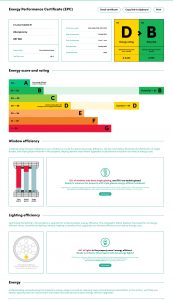
Here is why. A property with a low EPC rating typically has poor insulation, inadequate heating, and insufficient ventilation. These three factors together create the conditions in which condensation forms, moisture accumulates, and mould grows. In contrast, a well-insulated property with an efficient heating system maintains more consistent internal temperatures and manages moisture more effectively. The EPC rating check result contains more useful information than the headline band.
Therefore, improving your EPCs rating is not just a regulatory compliance exercise. It is a direct intervention against the conditions that trigger Awaab’s Law enforcement.
Research from the English Housing Survey consistently shows that properties rated F and G have significantly higher rates of damp and mould than those rated C and above. Furthermore, properties rated D and E sit in an uncomfortable middle ground: they may not yet show visible mould, but the underlying conditions can deteriorate quickly in cold or wet weather.
What Awaab’s Law Requires Landlords to Do
Under Awaab’s Law as currently applied to social housing, landlords must investigate reports of damp and mould within 14 days. They must then provide a written summary of findings. If the problem poses a significant risk to health, they must begin repair works within a further seven days.
Emergency hazards must be addressed within 24 hours.
These timeframes are tight. In addition, the burden of proof sits with the landlord to demonstrate they have acted promptly and effectively. Failure to comply exposes landlords to enforcement action, compensation claims, and reputational damage.
For private landlords, the existing Housing Health and Safety Rating System (HHSRS) already allows local authorities to take enforcement action against damp and mould hazards. Awaab’s Law tightens this framework and signals a harder regulatory environment ahead.
How EPCs Help Landlords Get Ahead of Compliance
Improving your EPCs rating before problems arise is far cheaper than responding to enforcement action after they do. Here is how better energy performance reduces Awaab’s Law risk in practice.
Wall insulation reduces cold surfaces. Cold internal wall surfaces are where condensation forms first. Adding wall insulation raises the surface temperature of walls, which reduces condensation and the mould growth that follows.
Loft insulation reduces heat loss. A warm, consistently heated property manages moisture better than a cold one. Loft insulation is one of the most cost-effective ways to improve EPCs ratings and maintain internal temperatures.
Improved ventilation addresses moisture at source. Many low-rated properties lack adequate ventilation. Mechanical ventilation with heat recovery (MVHR) or even simple trickle vents can reduce indoor moisture levels significantly.
Each of these improvements contributes to a higher EPCs rating and directly reduces the conditions that create damp and mould liability.
What EPCs Rating Do You Need?
The current minimum EPCs requirement for private rented properties in England is E. However, the government has proposed raising this to C for new tenancies by 2028 and for all tenancies by 2030.
Properties rated F or G cannot legally be let without a valid exemption. Properties rated D or E face increasing scrutiny as the regulatory environment tightens. As a result, landlords who act now to improve their EPCs rating are investing in compliance rather than chasing it.
For a comprehensive overview of what EPCs cover and how ratings are calculated, see our full guide to EPC certificate
Grants That Can Help Landlords Improve EPCs Ratings
The good news is that improving a property’s EPCs rating does not always require full self-funding. ECO4 and the Warm Homes Plan both fund insulation and heating upgrades for eligible properties. Eligibility depends on the tenant’s benefit status and the property’s current EPC rating.
If your tenants receive Universal Credit, Pension Credit, or other qualifying benefits, your property may qualify for fully funded wall insulation, loft insulation, or heating upgrades. These are precisely the measures that improve EPCs ratings and reduce Awaab’s Law risk simultaneously.
For a full breakdown of what funding is available, see our sister site’s guide to wall insulation grants.
The Landlord Risk of Waiting
The convergence of EPCs minimum standards, Awaab’s Law, and the Warm Homes Plan creates a clear message for landlords in 2026: the regulatory environment is tightening on multiple fronts at once. Properties with poor energy performance face higher damp and mould risk, stricter enforcement timelines, and shrinking grant windows.
In contrast, landlords who improve their EPCs ratings now reduce their legal exposure, access available grant funding, and future-proof their portfolio against incoming regulation. The cost of acting is manageable. The cost of not acting is growing.
Check Your EPCs Rating and Compliance Risk Today
 Whether you need a new EPCs assessment, want to understand your compliance obligations under Awaab’s Law, or are looking for the most cost-effective route to a higher rating, contact us today. We arrange qualified assessors across England with fast turnaround and same-day lodging on the official register.