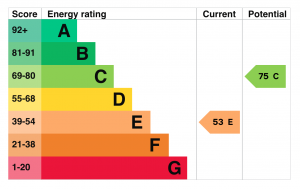
Average EPC rating UK by property type: Understanding how EPC ratings distribute across the UK housing stock. Read on to find out which improvement measures move properties between bands, matters for homeowners planning improvements, landlords facing the 2030 compliance deadline, and anyone trying to understand what their current rating actually means. The data from government published sources provides a clear picture of where the UK housing stock stands and what the evidence shows about effective interventions.
Where the UK Housing Stock Sits Today
Government EPC data for England and Wales, published through the EPC Register, shows that the average EPC rating for existing dwellings sits around band D, specifically in the low to mid D range, corresponding to a score of approximately 60 to 65 on the 1 to 100 scale.
This average conceals significant variation by property type, age, and tenure:
New builds (post 2010), the overwhelming majority rate at B or C. Government statistics for Q3 2025 show that 85% of new dwellings received an A or B rating, reflecting the progressive tightening of building regulations over the past two decades.
Post war housing (1945 to 1980), typically rates at C or D, depending on what improvements have been made. Cavity walls filled and loft insulated push these properties to the C boundary. Unimproved, they sit solidly in D.
Victorian and Edwardian properties (pre 1919): solid wall construction, single glazing, and older heating systems combine to produce E, F, or G ratings in unimproved form. These properties are the ones the government’s retrofit programmes primarily target.
Private rented sector: data from the 2024 English Housing Survey identifies private rented households as having the highest rates of fuel poverty of any tenure type in England, which correlates with a concentration of lower EPC rated stock in this sector.
The Social Housing Decarbonisation Fund: Before and After Evidence
The most useful published dataset on EPC improvement from specific interventions comes from the Social Housing Decarbonisation Fund (SHDF). The government’s December 2025 SHDF statistics provide specific before and after EPC data for tens of thousands of upgraded properties.
The headline finding is striking: almost 100% of households upgraded under SHDF Wave 2.1, those starting from EPC band D or below where pre and post installation data was available, reached band C or above following the programme of works. This was replicated across Wave 2.2, where 99% of upgraded households reached C or above.
This data reflects a package approach, multiple measures installed together rather than a single intervention. However, it demonstrates clearly that moving a poorly rated property to band C or above is achievable at scale when the right combination of measures is applied.
The measures installed under the SHDF were predominantly insulation measures, which accounted for 52% of all measures under Wave 2.1. Solid wall insulation (both external and internal) and other insulation measures including roof and floor insulation made up the majority of this share, alongside electricity related measures (22%) and windows and doors upgrades (16%).
What Individual Measures Contribute to an EPC Score
The EPC score is calculated using the Standard Assessment Procedure (SAP), which weights measures by their contribution to the overall energy demand and carbon output of the property. The contribution of each measure varies by property type, but some broad patterns hold:
Loft Insulation
Upgrading from no insulation to 270mm significantly reduces the calculated heat loss through the roof. The EPC impact is typically 5 to 15 points, with larger impacts on detached properties with a proportionally larger roof area. Loft insulation is usually the highest impact per pound spent measure available for an unimproved property.
Cavity Wall Insulation
Filling an unfilled cavity wall typically adds 8 to 20 points to the EPC score, depending on the property type and what other measures are present. For a solid brick semi the calculation is different, there is no cavity to fill, but for the majority of post 1930 properties with unfilled cavities, this is one of the most cost effective EPC improvements available.
Solid Wall Insulation (External or Internal)
The EPC impact of solid wall insulation depends heavily on how much exposed external wall the property has. A detached property with four external elevations sees a much larger improvement than a mid terrace with only front and rear.
Published data from the London EPC practice provides a worked example: a 100 year old solid brick end of terrace property rated F31 moved to D55 following solid wall insulation to a U value of 0.30 W/m²K, a 24 point improvement. The same property with additional insulation to a U value of 0.22 moved only one further point to D56, illustrating that there is a point of diminishing returns beyond building regulations compliance.
For detached solid wall properties, improvements of three EPC bands, for example E to B, are possible from solid wall insulation combined with other measures.
Heating System Upgrade
Replacing an old G rated gas boiler with a modern A rated condensing boiler adds around 3 to 8 points. A move to an air source heat pump produces a larger improvement in the current SAP methodology because heat pumps use electricity, which SAP weights more favourably than gas on a carbon basis.
However, from 2027 the new Home Energy Model (HEM) will introduce a different assessment methodology. Under HEM, heat pump performance is assessed differently and properties currently rated C on a gas boiler may see their rating change. Homeowners planning improvements ahead of this change should be aware that the methodology itself is moving.
Double Glazing
Moving from single glazed to double glazed windows typically adds 2 to 8 points. There may be larger impacts on properties with more glazing area. The marginal improvement from double to triple glazing is considerably smaller and rarely the most cost effective next step.
Solar Photovoltaic Panels
A 2 to 4kWp solar PV system adds approximately 10 to 20 points to the EPC score under the current methodology. Solar PV is therefore one of the highest impact individual measures for EPC score improvement, particularly on properties where fabric improvements alone leave the rating below C.
The 39% Who Moved Up a Band
Analysis by Hamptons of Ministry of Housing, Communities and Local Government data found that between January and August 2024, 39% of rental homes with new EPC assessments moved into a higher band compared to their previous certificate. More than one in 10 (13%) dropped into a lower band, while 48% saw no change.
This data reflects a housing stock in active transition, with a significant minority of landlords and homeowners making improvements between EPC cycles. Over half of rental properties assessed in this period had a rating of C or higher.
The government estimates that up to 4% of rental properties will not be able to achieve a minimum EPC rating of C regardless of investment. Typically, the most technically constrained properties including some listed buildings and properties in specific conservation areas.
What This Means for Your Property
The national data provides useful context but property level performance depends on the specific construction, existing measures, and what the EPC assessor has recorded. The practical starting point for any homeowner or landlord planning improvements is their existing EPC certificate, specifically:
The current score and band. Where do you actually sit on the scale?
The potential score. What does the EPC assessor calculate the property could achieve if all recommended measures were implemented?
The recommended improvements table. Which measures does the assessor identify, what is their estimated impact, and in what order should they be implemented?
The gap to C. If the current rating is D 65 and the potential is C 72, you need 3 points. If the current rating is E 45 and the potential is C 74, you need 29 points. The measures required are very different.
An EPC that is more than five years old may not reflect recent improvements or the updated RdSAP 10 methodology introduced in June 2025. If you are planning improvements based on an old EPC, commissioning a new assessment first gives you an accurate baseline.
Frequently Asked Questions
What is the average EPC rating in the UK? The average for existing dwellings in England and Wales is approximately D, in the range of 60 to 65 on the 100 point scale. New builds average B.
What percentage of homes have an EPC rating of C or above? Over half of rental properties assessed in 2024 rated C or above, according to Hamptons analysis of government data. The proportion varies significantly by tenure and property age. New builds are predominantly A or B, while pre 1919 solid wall properties are predominantly E, F, or G unless improved.
Which measures move an EPC rating the most? Solid wall insulation on a detached property, solar PV, and heat pump installation typically deliver the largest individual score improvements. Loft insulation delivers the best impact per pound spent for unimproved properties. The optimal combination depends on the specific property.
Does the SHDF data apply to privately owned homes? The SHDF targeted social housing, so the properties and measures differ from the typical private owner occupier or landlord scenario. The before and after band improvement data is indicative of what is achievable with a comprehensive package of measures but. However, this should not be taken as a direct prediction for any individual property.
Statistics and scheme data correct as of April 2026. EPC methodology is subject to change under the Home Energy Model from 2027, monitor government guidance for updates.