Understanding what happens if my property fails EPC requirements is increasingly important for UK landlords and homeowners in 2026. The legal consequences are real and growing more serious as minimum standards tighten, but the warm and dry spring that the UK has just come through added a dimension to this question that goes beyond compliance. Properties that fail their EPC are not just legally problematic. They are also thermally weak in ways that last spring made genuinely uncomfortable for the people living in them.
This guide covers what failing an EPC means in practice, what the legal position is for landlords, and why acting this summer rather than waiting is the right response.
What Does Failing an EPC Mean?
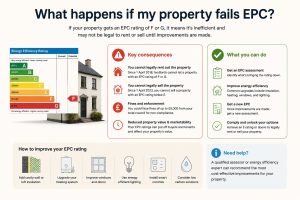
An EPC rates properties on a scale from A to G. Currently, the minimum acceptable rating for a privately rented property in England and Wales is E. A property rated F or G is considered to have failed the minimum standard and cannot legally be let to new tenants. Landlords who let properties below the minimum standard face civil penalties of up to 5,000 pounds per property.
For homeowners who are not renting their property, there is no current legal requirement to achieve a minimum EPC rating. However, when selling, the certificate must be available to buyers, and a low rating increasingly affects sale price and time on market as buyers factor energy costs into their decisions.
What Happens If My Property Fails EPC Requirements as a Landlord?
If your rental property currently sits at F or G, you are already in breach of the Minimum Energy Efficiency Standards unless an exemption applies. Exemptions are available in limited circumstances, including where the cost of improvements would exceed the current cap, where all relevant improvements have already been made and the rating remains below E, or where planning constraints prevent the necessary works.
Exemptions must be registered on the national PRS Exemptions Register. Simply being aware that the property fails the minimum standard is not sufficient. Unregistered non-compliance leaves landlords fully exposed to enforcement action by local authorities.
Looking ahead, the minimum standard is expected to rise to C for new tenancies in the coming years. Landlords whose properties currently sit at D or E should not treat current compliance as a long-term comfort. The direction of travel is clear, and properties that are difficult or expensive to upgrade to C will become progressively harder to let and less valuable as rental assets.
The Comfort Dimension: What Last Spring Revealed
The question of what happens if my property fails EPC is usually framed in terms of legal risk, and that framing is correct as far as it goes. However, the warm and dry spring that preceded this summer added a practical dimension that many landlords and homeowners had not previously considered.
Properties rated F and G are, by definition, poorly insulated. That insulation deficiency means heat escapes in winter and enters in summer. Last spring’s sustained warm dry weather made the entering-in-summer part of that equation directly and uncomfortably visible. Tenants in low-rated properties experienced higher indoor temperatures, greater discomfort, and in some cases significant disruption to sleep and daily routine during a prolonged warm spell.
For landlords, that has practical implications beyond the regulatory ones. Tenant dissatisfaction, complaints, and in some cases early termination of tenancies can all follow from persistent thermal discomfort. As warm springs become more likely to recur, that risk does not go away on its own.
What to Do If Your Property Fails Its EPC
The starting point is understanding exactly where the property sits and what improvements are needed to bring it up to the required standard. If you do not have a current certificate, commissioning one is the first step. A qualified Domestic Energy Assessor will identify the specific measures required and estimate the cost and saving for each one.
The most common improvements that move a failing property up the rating scale are loft insulation, cavity or solid wall insulation, floor insulation, and heating system upgrades. In many cases, a combination of two or three measures is sufficient to move from F or G to E or above.
Where eligible, grant funding through ECO4 and the Great British Insulation Scheme can cover some or all of the cost of these improvements for qualifying households and landlords. Your assessor or a registered installer can confirm eligibility.
Acting this summer means improvements can be planned, funded, and installed before the next heating season, and before next spring arrives. If last spring was uncomfortable for your tenants or for you, the summer that follows it is the most logical window to act.
Internal Links: For information on the EPC register and how to look up your current certificate, see our EPC register guide. For guidance on EPC certificate cost, read our dedicated cost guide.
Sister Site Links: For wall insulation options that can move a failing property up the rating scale, wallinsulation.co.uk covers all the main systems and costs. For external wall insulation on solid-walled properties, ecoinsulation.co.uk has full guidance on what is involved.
 Take the Next Step
If you are asking what happens if my property fails EPC requirements, the most important thing is not to wait. The legal risk is real, the comfort consequences are now visible, and the solutions are well established. Contact a qualified assessor today to confirm your current rating and find out exactly what your property needs to meet the standard and perform well through whatever next spring brings.