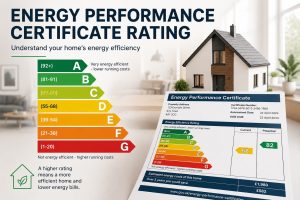
Your energy performance certificate rating measures how energy efficient your home is. It is scored from A to G. Ofgem will announce the next energy price cap level on 26 August 2026, which covers the period from October to December. Therefore, many homeowners are asking whether insulating now could improve their energy performance certificate rating before bills change again.
The short answer is yes, in most cases. However, how much your rating improves depends heavily on what your home currently lacks. A home with no loft or wall insulation at all will typically see a bigger jump. In contrast, a home that already has some measures in place will see a smaller one.
How Your Energy Performance Certificate Rating Is Calculated
Your energy performance certificate rating comes from an assessment of your home’s construction, heating system, and insulation levels. An assessor uses a standardised method called RdSAP. This estimates your home’s energy costs and carbon emissions. The result then gets converted into a band. This runs from A, the most efficient, down to G, the least efficient.
Insulation plays a significant role in this calculation. Heat loss through walls, floors, and roofs directly affects your estimated energy use. Because of this, improving any of these areas can shift your score. As a result, homes that add wall or floor insulation often move up at least one full band.
Why Timing Matters Right Now
Ofgem reviews the energy price cap every three months. The next announcement lands on 26 August 2026. It sets prices for October through December. Since this cap directly affects typical household bills, many homeowners use the announcement as a natural prompt to review their own energy costs.
Insulating before this announcement will not change the cap itself. However, it does mean your home enters the higher demand winter months already performing better. Therefore, any increase in the cap has less impact on your actual bill. Your home simply needs less energy to stay warm, regardless of the unit price.
What Actually Moves Your Rating
Different improvements carry different weight in the calculation. Loft insulation is often the cheapest way to gain a band. Heat rises, so it escapes through an uninsulated roof quickly. Wall insulation, whether cavity fill or external wall insulation, typically produces the biggest single jump for older properties. This is because walls account for a large share of total heat loss in solid walled homes.
Floor insulation contributes a smaller improvement, but it is still measurable. This matters especially in homes with suspended timber floors, since these let cold air move underneath the house. In addition, upgrading heating controls and improving glazing can help. However, these usually move a rating by less than a full band on their own.
Because every home is different, the exact improvement varies. A terraced house missing only floor insulation might move from a D to a C with that single measure. In contrast, a solid walled detached home starting from an F could potentially jump two full bands. This would come from external wall insulation, cavity top up where relevant, and loft insulation combined.
Why This Matters for Landlords Specifically
Landlords face an additional pressure beyond bills. Minimum standards for rented properties are tightening. In addition, a C rating is expected to become the baseline requirement for new tenancies before the end of the decade. As a result, landlords with properties currently rated D or below have a clear financial reason to act well before any deadline arrives.
Insulation upgrades often take weeks to arrange and complete. Because of this, starting now gives landlords a realistic chance of reaching compliance before demand for installers peaks. This applies both ahead of the autumn price cap announcement and ahead of the usual seasonal rush.
What a Rating Improvement Looks Like in Practice
Consider a typical 1930s semi detached home with cavity walls that have never been filled, and a loft with only 100mm of old insulation. Such a property often sits in band E or F. Filling the cavity and topping up the loft to current standards can move that home to band C in a single project, since both measures are relatively quick to install and address the two biggest sources of heat loss.
A solid walled Victorian terrace tells a different story. Because these properties have no cavity to fill, external or internal wall insulation becomes the main lever available. Therefore, the improvement often takes longer to plan and costs more upfront. However, the resulting jump in rating, and in comfort, tends to be larger than for a comparable cavity walled home.
Timing an Assessment Around Your Improvements
It is worth booking your assessment after any insulation work completes, not before. An assessor can only record what currently exists in your home. As a result, booking too early means paying for a certificate that misses the improvement altogether, and needing a second assessment later to capture it.
However, if you do not yet have a current certificate, it is still worth getting one first. This gives you a clear baseline and a documented list of recommended measures to work from, rather than guessing which improvements matter most for your specific property.
Questions to Ask Before Booking an Assessment
Before booking any work, it helps to ask a few questions first. Ask whether your current certificate is still valid, since certificates last ten years and older ones may no longer reflect your home accurately. In addition, ask an assessor which single measure would move your energy performance certificate rating the furthest, rather than assuming every improvement carries equal weight.
Finally, ask whether any recommended measure qualifies for grant support through ECO4 or the Warm Homes Plan. Since eligibility depends on your current rating and household circumstances, it is worth checking before ruling anything out on cost alone.
Checking and Improving Your Rating
Before booking any work, check your current energy performance certificate rating and see which recommendations your existing certificate lists. For a full explanation of what specific measures improve a rating the most, our guide on how to improve your EPC rating breaks down each option in detail.
For official information on the current energy price cap and how it is calculated, Ofgem’s energy price cap guidance explains what determines the level and when the next change takes effect.
If wall insulation is the measure your certificate recommends, our sister site wallinsulation.co.uk has a complete guide to wall insulation covering cavity fill, internal options, and external wall systems.
 Book Your Assessment Before Autumn
Your energy performance certificate rating reflects real, measurable improvements, not guesswork. Insulation remains one of the most reliable ways to move up a band. Book an assessment now, before the autumn price cap announcement lands. Do this before installer diaries fill up for the season too. Find out exactly what your home needs to reach a better rating this year.