If you had an EPC assessment before June 2025 and are now getting a new one, the score may be different from what you expected, even if nothing has changed about the property. On 15 June 2025, the methodology used to calculate EPC ratings for existing homes in England and Wales changed from RdSAP 9.94 to RdSAP 10. This was the most significant update to the EPC assessment methodology in over a decade, and it affects how some properties score, how assessors collect information, and what documentation homeowners need to provide.
EPC band ratings explained: What EPC Bands Mean and How They Are Calculated
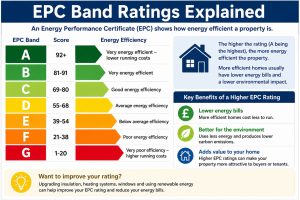
An EPC rates a property on a scale of 1 to 100, divided into seven bands:
| Score | Band |
|---|---|
| 92 to 100 | A |
| 81 to 91 | B |
| 69 to 80 | C |
| 55 to 68 | D |
| 39 to 54 | E |
| 21 to 38 | F |
| 1 to 20 | G |
The score calculates using the Standard Assessment Procedure (SAP) for new buildings and the Reduced Data SAP (RdSAP) for existing homes, “reduced” because an assessor visiting an existing building collects a defined set of data points rather than the full design specifications available for new construction.
The score represents the estimated energy cost of heating, lighting, and hot water for the property under standard occupancy assumptions. It does not reflect actual energy use, which varies with occupant behaviour, the number of people in the property, and energy tariffs.
What RdSAP 10 Changed
The June 2025 update made changes across several areas of the assessment methodology. The most significant for homeowners and landlords are:
Evidence Based Assessment Replaces Default Assumptions
Under the previous methodology (RdSAP 9.94), assessors frequently relied on default assumptions when specific information was unavailable. For example, if the make and model of a boiler could not be verified, the system used a default efficiency figure, often lower than the actual boiler’s performance. If insulation was present but the installer certificate was unavailable, the assessor might not be able to record it accurately.
RdSAP 10 introduces a hierarchy that prioritises actual evidence over assumptions. An assessor who can verify the boiler model and manufacturer data uses the actual efficiency figure. An assessor who cannot provide evidence uses a lower default that reflects the uncertainty.
The practical consequence for property owners is that documentation matters more under RdSAP 10 than it did before. Keeping records of:
- Boiler make, model, and installation date
- Insulation certificates or building regulations completion certificates
- Window installation certificates showing glazing type and installation date
- Solar panel installation records
These documents allow an assessor to use better performance data in the calculation, which can meaningfully affect the score.
Revised U Values for Solid Walls
The previous methodology used a fixed default U value of 2.1 W/m²K for solid brick walls, applied regardless of the actual wall thickness. RdSAP 10 introduces a step change for solid brick walls: properties with walls thicker than 280mm now receive a default U value of 1.4 W/m²K rather than 2.1 W/m²K.
This change is based on evidence from research showing that the actual U value of UK solid walls is on average closer to 1.3 W/m²K than the previously assumed 2.1 W/m²K. The revision makes EPCs more accurate for solid wall properties, but it also means that some solid brick properties score slightly better than they did under the previous methodology, purely from the methodology change, with no physical improvement to the building.
For solid stone walls, sandstone, limestone, and granite, RdSAP 10 also provides revised U values, with slightly more generous figures for the thick stone walls typical of older Scottish and northern English construction.
Improved Handling of Flats and Terraced Properties
Previous versions of RdSAP applied default assumptions about heat loss through party walls and shared floors and ceilings that could understate the performance of mid floor flats and mid terrace properties. RdSAP 10 adjusts these calculations, which may result in improved scores for some flat and terrace properties even without any physical changes.
Heating System Evidence Requirements
The RdSAP 10 hierarchy requires assessors to record the specific make and model of heating systems where this can be verified. Smart heating controls, programmers, thermostats, and thermostatic radiator valves, are captured more accurately where the assessor can confirm their presence.
For properties with heat pumps, RdSAP 10 captures more detail about the specific heat pump model and its Seasonal Coefficient of Performance (SCOP), which affects the score more precisely than the previous methodology’s more generalised treatment of heat pump installations.
How Your Score May Have Changed
Some property types are more affected by the RdSAP 10 changes than others:
Solid brick properties with walls over 280mm thick, these properties may score slightly better under RdSAP 10 due to the revised U value, even with no physical improvement.
Properties with documented improvements, where the owner can provide installer certificates and documentation, the assessor can record better performance data, producing a more accurate (and often higher) score than under a default assumption methodology.
Flats and terraced houses, the revised heat loss assumptions for shared elements may produce modestly improved scores.
Properties with unverified heating systems, where a boiler’s details cannot be confirmed, the new methodology may apply a lower efficiency default than before, potentially producing a worse score for the same boiler.
EPC band ratings explained: What Homeowners Should Do Before a New Assessment
Given the evidence requirements under RdSAP 10, prepare for any new assessment by gathering:
Boiler documentation. The installation certificate from when the boiler was installed, or at minimum the make, model, and installation year. If the current boiler replaced an original system, the replacement paperwork is what matters.
Insulation records. Building regulations completion certificates for any insulation installed since 2002. Installer certificates from loft, wall, or floor insulation installed under government schemes. Even a dated invoice from an insulation company is better than nothing.
Window installation records. FENSA certificates or equivalent for double or triple glazing installed since 2002. These confirm the glazing type and installation date.
Solar panel records. The installer certification and any MCS (Microgeneration Certification Scheme) documentation for solar PV or solar thermal.
Heat pump documentation. The make, model, and SCOP figure from the installation certificate.
An assessor working from good documentation produces a more accurate assessment than one working from default assumptions. For some properties, the difference between a documented and an assumed assessment can be several EPC points, enough to cross a band boundary.
The Next Methodology Change: Home Energy Model from 2027
RdSAP 10 is not the last change coming. The government is developing the Home Energy Model (HEM) as a replacement for the current SAP and RdSAP framework. HEM is expected to be ready in the second half of 2027.
Under HEM, domestic EPCs will move to four new headline metrics: fabric performance, heating system performance, smart readiness, and energy costs. The single band rating from A to G will be supplemented with these additional metrics.
The implications for properties currently rated C are significant. A property that achieves C under RdSAP 10 may score differently under HEM if its heating system changes how it is assessed. The government has confirmed that EPCs issued under the current methodology will remain valid for 10 years, so an EPC C obtained before HEM takes effect will not automatically require reassessment.
Homeowners and landlords who achieve a valid EPC C before October 2029 under the current methodology lock in compliance for up to 10 years, avoiding the more demanding HEM requirements during that period.
EPC band ratings explained: Frequently Asked Questions
Why is my new EPC score different from my old one when nothing has changed? The RdSAP 10 methodology change may have affected your score. Solid brick properties with thick walls, terraced properties, and flats may all see changes due to revised calculation assumptions. Changes in documented evidence, either better documentation producing a higher score or less documentation producing a lower one, also explain differences between assessments.
Does RdSAP 10 make it easier or harder to achieve an EPC C? It depends on the property. Solid brick properties with thick walls may find it slightly easier due to the revised U value. Properties where the owner cannot provide boiler or insulation documentation may find the new evidence hierarchy means their score is lower than a previous assessment that used more generous defaults.
Is an EPC from before June 2025 still valid? Yes. EPCs remain valid for 10 years from the date of issue, regardless of methodology changes. A certificate from 2018 is valid until 2028 for the purpose of a sale or letting. However, it does not reflect RdSAP 10 and may not accurately represent the property’s performance under the current methodology.
Do I need a new EPC because of RdSAP 10? Not unless your existing certificate has expired or you are undertaking a transaction that requires a current certificate. If you are planning improvements and want an accurate baseline, commissioning a new assessment under RdSAP 10 gives you a starting point that reflects the current methodology.
 Information correct as of April 2026. EPC methodology continues to evolve, monitor government guidance for the transition to the Home Energy Model from 2027.